Virtual Synchronous Generator: Key Enabler of Renewable Energies Integration
Abstract
 The modern electricity system is evolving from a system based on synchronous machines to a system dominated by inverters with the wide spread penetration of renewable energy sources (RES) such as wind power and photovoltaics. RES units now account for a significant proportion of generation, and the traditional approach of integrating them as ‘Grid Following’ units can lead to frequency instability. Intensified research is now being directed towards the use of inverters with virtual inertia control algorithms so that they appear as synchronous generators on the grid. In this way, grid stability can be ensured and massive deployment of renewable energy can be managed. This presentation consists of giving the basic ideas of the concept of virtual synchronous generators and their application in the field of renewable energy integration.
Prof. Aissa Chouder received the Ingénieur and Magister in Electronics degrees from Ferhat Abbas University, Sétif, Algeria, in 1991 and 1999,respectively, and the Ph.D. degree in electronic engineering from the Universitat Politècnica de Catalunya (UPC), Barcelona, Spain, in 2010. He is currently full Professor with the electrical engineering department, University Mohamed Boudiar M’sila, Algeria and head of the Eletrcial Engeneering Laboratory (LGE). He has co-authored more than 150 papers in international journals and conference proceedings. His research interests include power electronics modeling, control of renewable energy systems and microgrids.
Implantation and study of hydroponic greenhouse systems
 This work presents the experimental and numerical study of the Manouba hydroponic greenhouse and is part of the Tunisian-Italian INTESA project. This greenhouse is a functional prototype that can be duplicated of an above-ground production system for aromatic herbs and any other type of vegetable or flower in flat culture and stem. This greenhouse is made up of several equipments includes hydraulic, irrigation, misting, lighting, ventilation, shading systems and electricity. To do this, we are interested in the experimental study of the aerothermal parameters within the greenhouse by measuring devices. In parallel with this experimental study, a numerical study is developed using Ansys Fluent 16.2 software for the analysis of the local characteristics of the greenhouse. The comparison of our numerical and experimental results shows a good agreement and confirms the validity of the adopted analysis method. The results found are encouraging and favorable to be considerd in order to reproduce our model on the rest of the Tunisian territory.
Keywords: Hydroponic greenhouse; aerothermal; experimentation, numerical simulation.
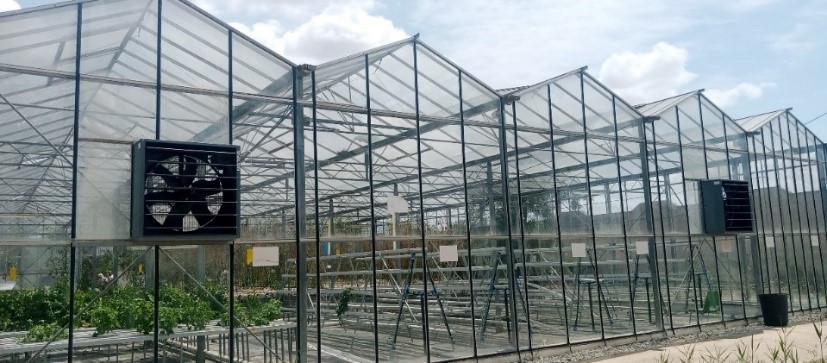
Graphical abstract